Disaster in pasta land.
As you may remember, I got a pasta maker back in July. Since then, I've been making homemade pasta about once a week. Well, last week disaster struck.
Apparently, you can put a brush through a pasta maker.
Long story, but the basics are that you're not supposed to use water to clean the dies that cut the pasta. You let them dry, brush them off, blow the flour out—pretty simple. So, with the dies spinning, I decided I could very gently hold a brush against them and clean them as they turned.
I know. Idiot move.
Before I could react, the die grabbed the bristles and sucked the entire brush in. The motor kept turning. The dies didn't. And the next thing I knew, the gears inside my $150 motor had shredded themselves. The motor is now in the trash can, and I'm back to store-bought pasta until I convince myself to order another one.
Fortunately, the timing wasn't all bad.
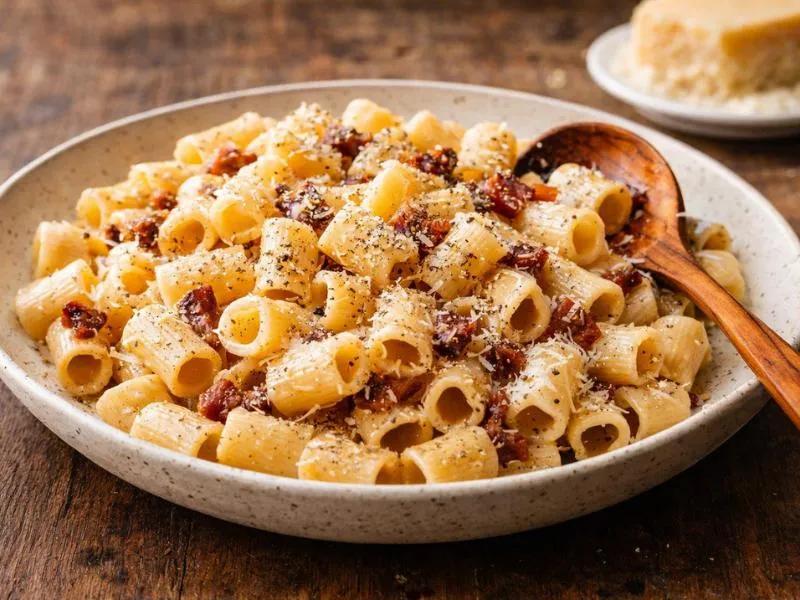
A few days later, I came across a pasta dish I'd somehow never seen before: Pasta alla Gricia. And since rigatoni seemed like the right pasta for it anyway—and my machine isn't an extruder—store-bought pasta wasn't much of a concession.
If you're like me and Instagram has figured out that you like to cook, you've probably been served Cacio e Pepe this and Cacio e Pepe that. You may not know this about me, but I'm a bit of a contrarian, so despite seeing it approximately 4,000 times, I've never made it.
I do, however, love spaghetti carbonara.
Alla Gricia sits somewhere between the two. You get the guanciale and rendered fat that make carbonara so good, but leave out the egg. Then you bring in the Pecorino Romano and black pepper that make Cacio e Pepe what it is.
Four basic ingredients: pasta, guanciale, Pecorino Romano and black pepper.
And after making it, I may have found another reason not to replace that pasta motor quite yet.
Serves 4 | 30–35 minutes
Ingredients
- 400 g dried rigatoni
- 175 g guanciale, cut into ¼-inch-thick, ¾- to 1-inch-long strips
- 125 g Pecorino Romano, freshly and very finely grated
- 1½–2 teaspoons freshly cracked black pepper
- At least 2 cups reserved starchy pasta water
- Salt for the pasta water, used sparingly
Instructions
1. Render the guanciale. Put the guanciale in a cold skillet and set it over medium-low heat. Cook slowly for 10–15 minutes, until golden with crisp edges but still a little chewy in the center. Remove the guanciale and set it aside, leaving about 2–3 tablespoons of rendered fat in the skillet.
2. Cook the rigatoni. Bring about 3 quarts of lightly salted water to a boil. Cook the rigatoni until roughly 2 minutes shy of al dente. Before draining, reserve at least 2 cups of that starchy pasta water.
3. Make the Pecorino paste. Put the finely grated Pecorino in a mixing bowl. Add about ¼ cup of warm—not boiling—pasta water, a little at a time, stirring vigorously. Continue adding water by the tablespoon until you have a smooth, thick paste, somewhere around the consistency of soft mashed potatoes or thick hummus.
4. Bloom the pepper and finish the pasta. Warm the rendered guanciale fat over medium-low heat. Add the black pepper and toast it for about 30 seconds. Add ½ cup of pasta water and the rigatoni. Toss over medium heat until the pasta reaches al dente and the fat and starchy water become cloudy and lightly emulsified. Add more pasta water as needed.
5. Turn the heat OFF. Not down. Off. Especially if you're using cast iron, which is going to hold onto a lot of heat. Transfer the pasta and its saucy liquid to a room-temperature mixing bowl and toss briefly to let some of that heat dissipate.
6. Add the Pecorino paste. Add half of the cheese paste and toss vigorously. Add the rest and continue tossing, adding warm pasta water 1–2 tablespoons at a time until everything becomes glossy and creamy. Don't put it back over direct heat. The residual heat from the pasta is enough.
7. Finish it. Fold in most of the guanciale. Serve immediately in warm bowls, topping each with the remaining guanciale, some additional black pepper and a little extra Pecorino.
One important lesson from my first attempt: don't dump dry Pecorino directly into screaming-hot pasta and expect it to magically become a creamy sauce. Mine turned stringy. Making the Pecorino paste first and getting the pasta completely away from direct heat before adding it makes all the difference.







Leave a comment